Winter hits your car's battery harder than almost anything else under the hood. Cold temperatures slow down the chemical reactions inside a battery, which means less power available right when your engine needs it most. If you own a 2005 Nissan Altima and you live somewhere that gets freezing winters, picking the right battery group size isn't just a detail it's what stands between you and a car that won't start on a cold Monday morning.
What battery group size does a 2005 Nissan Altima actually need?
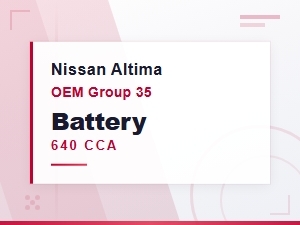
The answer depends on which engine your Altima has. The 2.5-liter four-cylinder model uses a Group 35 battery, while the 3.5-liter V6 model uses a Group 24F battery. These group sizes defined by the Battery Council International (BCI) tell you the battery's physical dimensions, terminal placement, and general electrical specifications.
Group size isn't something you guess or swap around. If you install the wrong one, the battery may not fit the tray, the terminals may not reach, or the hold-down clamp won't secure it properly. All of those problems get worse in winter when vibrations from rough, salted roads can knock a poorly fitted battery loose.
Why does winter make battery group size so important?
At 80°F (27°C), a fully charged car battery operates at close to 100% capacity. Drop the temperature to 0°F (-18°C), and that same battery can lose up to 60% of its cranking power while the engine simultaneously demands more energy to turn over thickened oil. This mismatch is why dead batteries are one of the most common roadside problems every winter.
The right group size ensures your battery has the correct Cold Cranking Amps (CCA) rating for your engine's displacement. A Group 35 battery typically delivers between 640 and 750 CCA, which is enough for the 2.5L Altima. The Group 24F, used in the V6 model, usually offers 700 to 800 CCA, accounting for the larger engine's higher starting demands.
What CCA rating should you look for in winter?
For the 2005 Nissan Altima, aim for a battery with at least 600 CCA if you live in a mild climate. If you regularly face temperatures below 20°F (-7°C), go higher 700 CCA or more gives you a much better safety margin. You can always go above the minimum CCA; you just can't go below it and expect reliable cold starts.
Can you use a different group size than what Nissan recommends?
Some owners wonder if a Group 24F can fit in a 2.5L Altima, or if a Group 35 works in the V6. The short answer: stick with what Nissan specifies. The battery tray, terminal orientation, and cable lengths are engineered for a specific group size. A Group 24F is physically larger than a Group 35, so it won't sit properly in a tray designed for the smaller battery.
That said, there's one exception worth noting. Some aftermarket manufacturers offer Group 35 batteries with enhanced CCA ratings that bridge the gap between standard Group 35 performance and what you might expect from a larger battery. These are fine as long as the dimensions and terminal positions match.
What's the difference between Group 35 and Group 24F batteries?
Here's a quick comparison that makes the distinction clear:
- Group 35: Approximately 9.06 × 6.88 × 8.75 inches. Terminals on the top, with the positive terminal on the left. Common in many Nissan and Honda models.
- Group 24F: Approximately 10.25 × 6.81 × 8.88 inches. Also top-terminal, but larger overall footprint. Frequently used in Nissan V6 and some Toyota models.
The size difference may look small on paper, but even half an inch matters when you're trying to secure a battery into a stamped steel tray. If you want help identifying the exact group size from your current battery, we cover that in our guide to identifying your battery group size yourself.
What battery brands perform best for the 2005 Altima in winter?
You don't necessarily need the most expensive battery on the shelf, but you do want a reputable brand with solid cold-weather performance. Options that consistently perform well include:
- Interstate Mega-Tron Plus (MTX-35 or MTX-24F) widely available and known for reliable CCA delivery in cold weather.
- Optima RedTop (35 or 75/25) spiral-cell design that handles vibration well, which helps on winter roads.
- ACDelco Professional (48AGM or 78-6YR) AGM technology holds charge longer during cold spells when the car sits unused.
- DieHard Gold (Group 35 or 24F) solid mid-range option with good warranty coverage.
AGM (Absorbent Glass Mat) batteries cost more upfront, but they tend to hold their charge better in extreme cold, recharge faster, and last longer overall. If you live in Minnesota or upstate New York, the extra $40–$70 for AGM usually pays for itself in fewer dead-battery mornings.
What are the most common mistakes people make with winter batteries?
After years of helping Altima owners troubleshoot battery issues, these errors come up the most:
- Buying based on price alone. A cheap battery with low CCA might save you $30 today but leave you stranded when it's 5°F outside.
- Ignoring battery age. Most car batteries last 3–5 years. If yours is approaching that range, replace it before winter not after it fails.
- Wrong group size "close enough" thinking. As we covered above, fitting issues cause real problems. There's no "close enough" with battery group sizes.
- Skipping terminal cleaning. Corrosion on the terminals increases resistance, which is the last thing you need when cranking power is already reduced by cold.
- Forgetting about parasitic drain. Dashcams, phone chargers, and aftermarket electronics can drain a battery overnight. In summer you might not notice; in winter, that small drain can mean the difference between starting and not starting.
How do you install the right battery for winter?
Once you've bought the correct group size, installation is straightforward. Disconnect the negative terminal first, then the positive. Remove the hold-down bracket, lift out the old battery, and drop in the new one. Reconnect in reverse order positive first, then negative.
Before you tighten everything down, apply a thin layer of dielectric grease or anti-corrosion spray to the terminals. This small step prevents the white, crusty corrosion buildup that weakens electrical connections over winter months.
If you've never swapped a battery yourself, our step-by-step replacement walkthrough covers every move in detail. For a broader installation overview, check the full winter installation guide.
Should you use a battery tender or trickle charger in winter?
If your Altima sits for more than a few days at a time during winter say, you work from home or have a second vehicle a battery maintainer is a smart investment. These small devices plug into a standard outlet and keep your battery at optimal charge without overcharging it.
A fully charged battery freezes at about -76°F (-60°C). A discharged battery can freeze at just 32°F (0°C). That freezing can crack the battery case and destroy it completely. Keeping the battery topped off is the single best way to prevent winter battery failure on a car that doesn't drive daily.
Can you find reliable battery reference information online?
Yes the Montserrat of battery reference data comes from BCI (Battery Council International) standards, which define group sizes used across the industry. Your owner's manual and any auto parts store lookup tool will cross-reference the BCI group number with your specific vehicle.
Quick winter battery checklist for your 2005 Nissan Altima
- Confirm your engine size 2.5L needs Group 35, 3.5L V6 needs Group 24F.
- Check your current battery's date code if it's older than 4 years, plan to replace it before temperatures drop.
- Choose a battery with at least 650–700 CCA for reliable cold starts.
- Consider AGM technology if you live in a region with sustained freezing temperatures.
- Clean and grease terminals during installation to prevent corrosion.
- Use a battery maintainer if the car will sit unused for more than a few days.
- Keep jumper cables in the trunk as a backup even a new battery can struggle in extreme cold.
Getting the battery group size right for your 2005 Nissan Altima is a simple decision that prevents a big winter headache. Check your owner's manual, match the group size to your engine, invest in quality CCA ratings, and take care of the small maintenance steps. Your Altima will start reliably even on the coldest mornings.
 Nissan Altima Battery Group Size Identification Guide Diy
 Nissan Altima Battery Group Size Specifications and Installation Guide
 Nissan Altima Battery Group Size Purchase & Install Guide
 Nissan Altima Battery Size and Replacement Instructions Guide
 Nissan Altima Oem Battery Group Size and Cca Rating Guide
 Compatible Battery Group Size for 2005 Nissan Altima – Find the Right Fit