Your Nissan Altima won't start, the lights are dim, or you're hearing that dreaded clicking sound when you turn the key. The battery is usually the first thing to check. Knowing the correct Nissan Altima battery size and replacement instructions saves you time, money, and the frustration of buying the wrong part or paying a shop for a job you can finish in your driveway in under 30 minutes.
What battery size does a Nissan Altima use?
Most Nissan Altima models from 2013 to 2024 use a Group 35 battery. This is the standard size that fits the battery tray and aligns with the terminal positions on these vehicles. Some newer Altima trims or certain model years may call for a Group 48 (H6) battery, which is slightly different in dimensions and terminal layout.
The safest way to confirm your exact fitment is to check your owner's manual, look at the label on your current battery, or use a trusted group size guide for the Nissan Altima that breaks it down by year and engine type.
What does battery group size actually mean?
Battery group size is a standard defined by the Battery Council International (BCI). It tells you the physical dimensions (length, width, height), terminal placement, and terminal type of the battery. A Group 35 battery measures roughly 9.06 × 6.88 × 8.75 inches. If you install a battery with the wrong group size, it may not fit the tray, the cables might not reach, or the terminals could be on the wrong side all problems you want to avoid.
If you want a deeper breakdown of how battery group sizes work for this car, check out this resource on Nissan Altima battery sizing details.
What are the CCA ratings for a Nissan Altima battery?
Cold Cranking Amps (CCA) measure how much current a battery can deliver at 0°F for 30 seconds while maintaining at least 7.2 volts. For the Nissan Altima, the typical CCA range is 640 to 700 CCA for the standard Group 35 battery. Higher CCA numbers are fine they give you extra starting power in cold weather but going too low can cause hard starts, especially in winter.
For a model-by-model look at recommended CCA values and OEM battery specifications for the Altima, that breakdown covers what Nissan recommends versus what aftermarket options provide.
How do I replace the battery in a Nissan Altima?
Replacing the battery in a Nissan Altima is a straightforward job. Here are the steps most owners can follow at home with basic tools:
- Turn off the engine and remove the key from the ignition. Make sure all lights and accessories are off.
- Open the hood and locate the battery on the driver's side of the engine bay.
- Remove the negative (−) terminal first using a 10mm wrench. Loosen the clamp and lift the cable off. Tuck it aside so it doesn't touch the terminal.
- Remove the positive (+) terminal the same way.
- Remove the battery hold-down clamp. On most Altimas, this is a bracket at the base of the battery tray secured by a bolt. A 10mm or 12mm socket usually works.
- Lift the old battery out. Batteries weigh 35–45 pounds, so use both hands and lift with your legs.
- Clean the battery tray and terminal clamps with a wire brush or a baking soda and water mixture. Corrosion buildup affects performance.
- Place the new battery in the tray, making sure the positive and negative terminals are on the correct sides.
- Secure the hold-down clamp back in place.
- Reconnect the positive (+) terminal first, then the negative (−). Tighten the clamps firmly but don't overtighten you can strip the lead terminals.
- Start the engine to confirm everything works. Check that the clock, radio presets, and other settings may need to be reset.
Do I need to reset anything after replacing the battery?
On many Nissan Altima models, you may need to reset a few things after a battery swap:
- Power windows: Hold each window switch up for a few seconds after fully closing to recalibrate the auto-up function.
- Clock and radio presets: These usually reset and need to be set again manually.
- Idle relearn: Some Altimas benefit from an idle relearn procedure. Let the engine idle for about 10 minutes without touching the accelerator, or drive normally for 15–20 miles so the ECU can relearn idle parameters.
- Steering angle sensor: On models with electronic power steering, turn the wheel fully left, then fully right, then back to center to recalibrate.
What common mistakes do people make when replacing an Altima battery?
A few errors come up often with DIY battery replacements:
- Connecting terminals in the wrong order. Always disconnect the negative first and reconnect the positive first. Reversing this order can cause a short circuit.
- Buying the wrong group size. A Group 24F or Group 65 battery will not fit an Altima correctly. Always confirm the group size before purchasing.
- Ignoring terminal corrosion. Putting a new battery on dirty, corroded terminals limits the electrical connection and shortens battery life.
- Not securing the hold-down bracket. A loose battery can shift during driving, damage cables, or crack the case.
- Forgetting about the battery vent tube. Some Altimas (especially hybrid models) have a vent tube that must be connected to the new battery. Skipping this can cause dangerous gas buildup inside the cabin.
How long should a Nissan Altima battery last?
On average, a car battery lasts 3 to 5 years. In hotter climates like Arizona or Texas, batteries tend to die closer to the 3-year mark because heat accelerates internal chemical breakdown. In cooler regions, you might get 5 years or slightly more. If your battery is over 3 years old and you're noticing slow cranking or dim headlights, have it tested at an auto parts store most do this for free.
How much does a replacement battery cost for a Nissan Altima?
A replacement Group 35 battery for a Nissan Altima typically costs between $120 and $250, depending on the brand, CCA rating, and warranty length. Premium AGM (Absorbed Glass Mat) batteries cost more but last longer and handle frequent short trips and electronic loads better. If you want to learn about the typography behind clean dashboard displays and modern vehicle design elements, take a look at the Montserrat font, which is widely used in automotive UI.
Can I use an AGM battery in my Nissan Altima?
Yes. AGM batteries are a compatible upgrade for most Altima models. They recharge faster, handle deep cycling better, and are more resistant to vibration. Some newer Altima trims actually come with AGM batteries from the factory. If your car has a start-stop system, an AGM battery is the recommended type.
Quick checklist before you buy a new battery
- Confirm the BCI group size (Group 35 for most Altimas)
- Check the CCA rating matches or exceeds OEM specs (640–700 CCA)
- Decide between standard flooded and AGM based on your driving habits
- Look at the warranty a 3-year free replacement warranty is a solid baseline
- Verify terminal orientation (positive on the correct side)
- If your Altima is a hybrid, confirm the vent tube requirement
Next step: Grab your current battery's group size and CCA rating from the label, compare it against your owner's manual specs, and pick up the right replacement before your old battery leaves you stranded. A voltmeter reading below 12.4 volts means it's time to swap it out now rather than wait.
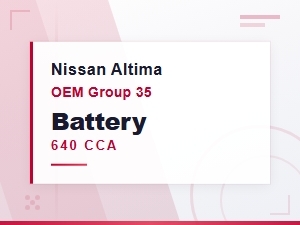 Nissan Altima Oem Battery Group Size and Cca Rating Guide
 Compatible Battery Group Size for 2005 Nissan Altima – Find the Right Fit
 Nissan Altima Battery Group Size Specifications by Year
 Nissan Altima Battery Group Size Guide by Year
 Best Battery Options for Your Nissan Altima
 Nissan Altima Battery Replacement Cost Estimate and Recommendations