Getting the right battery for your Nissan Altima isn't something you want to guess at. The wrong group size can leave you stranded, cause electrical issues, or even damage your car's charging system. That's why having a reliable Nissan Altima replacement battery group size guide matters it saves you time, money, and the headache of buying the wrong part twice. Whether your battery just died in a parking lot or you're planning ahead before winter hits, knowing the correct group size is the first step.
What Does Battery Group Size Actually Mean?
Battery group size is a standard set by the Battery Council International (BCI). It defines the physical dimensions length, width, and height as well as the terminal placement of a battery. It has nothing to do with how much power the battery puts out. Two batteries can have the same group size but different cold cranking amps (CCA) or reserve capacity.
For the Nissan Altima, the group size tells you which batteries will physically fit in the tray, line up with the terminal posts, and connect properly to your car's cables. If you're looking for the exact specifications, our battery group size specifications breakdown covers dimensions and terminal layout in detail.
What Battery Group Size Does My Nissan Altima Need?
The group size depends on your Altima's model year and engine type. Here's a quick reference:
- 2013–2018 Nissan Altima (2.5L 4-cylinder): Group 35
- 2013–2018 Nissan Altima (3.5L V6): Group 35
- 2019–2024 Nissan Altima (2.5L 4-cylinder): Group 48 (H6/L3)
- 2019–2024 Nissan Altima (2.0L VC-Turbo): Group 48 (H6/L3)
- 2007–2012 Nissan Altima (2.5L and 3.5L): Group 35
- 2002–2006 Nissan Altima (2.5L and 3.5L): Group 35
If you want a complete year-by-year breakdown, we've put together a full Nissan Altima replacement battery guide that covers every generation.
Why Did Nissan Switch From Group 35 to Group 48?
Starting with the 2019 model year, Nissan moved to Group 48 (also labeled as H6 or L3 depending on the brand). This change happened because newer Altimas come with more electronics advanced driver-assist features, larger infotainment screens, and start-stop technology. Group 48 batteries generally offer higher reserve capacity and are designed to handle the increased electrical demands of modern vehicles.
Group 48 batteries are also an AGM (Absorbent Glass Mat) compatible size. Many 2019+ Altimas benefit from AGM batteries, especially if the car has auto start-stop. If your Altima has this feature, an AGM battery isn't optional it's what the system was designed for.
Can I Use a Different Group Size Than What's Recommended?
Technically, some group sizes are close enough in dimensions that they might fit. For example, Group 24F is sometimes mentioned as a possible swap for Group 35. But there are real risks:
- Terminal polarity: The positive and negative terminals may be on opposite sides, which can cause cable strain or even short circuits.
- Height clearance: A taller battery can contact the hood or battery cover.
- Hold-down fitment: The battery tray and clamp are designed for a specific footprint. A wrong size can rattle loose.
Sticking with the recommended group size avoids all of these problems. Our replacement instructions and battery sizing guide walks through how to verify fitment before you buy.
What CCA Rating Should I Look For?
Cold Cranking Amps (CCA) measures how well a battery starts your engine in cold weather. For the Nissan Altima:
- Group 35 batteries: Look for at least 640 CCA. Many quality options range from 640 to 750 CCA.
- Group 48 (H6) batteries: Aim for 700 CCA or higher. AGM versions often deliver 760–800 CCA.
If you live in a region with harsh winters, going with a higher CCA rating gives you a safety margin. In warmer climates, CCA is less critical, but don't go below the minimum recommendation.
What Are the Most Common Mistakes People Make?
Buying Based on Price Alone
A cheap battery that dies in 18 months costs more in the long run than a mid-range battery lasting 4–5 years. Check the warranty terms a 3-year free replacement warranty usually signals a decent product.
Ignoring the Manufacturing Date
Batteries start degrading on the shelf. Look for the date code stamped on the case. Avoid anything more than 6 months old. A fresh battery will perform better and last longer.
Not Checking for AGM Requirements
If your 2019+ Altima has auto start-stop and you install a standard flooded battery, you'll likely see warning lights and experience poor performance. The vehicle's charging system expects an AGM battery's specific voltage behavior.
Forgetting to Register the New Battery
Some newer vehicles require battery registration through the OBD-II port so the charging system adjusts. While not all Altima model years require this, it's worth checking with your dealer or using a compatible scan tool if you have a 2019 or newer model.
How Long Should a Nissan Altima Battery Last?
On average, expect 3 to 5 years from a standard flooded battery and 4 to 6 years from an AGM battery. Several factors shorten battery life:
- Frequent short trips (under 15 minutes) that don't fully recharge the battery
- Extreme heat batteries in Arizona or Texas often fail sooner than those in moderate climates
- Leaving lights or accessories on while the engine is off
- A failing alternator that undercharges the battery over time
If your battery is over 3 years old, it's smart to have it tested at an auto parts store. Most offer free battery testing and can tell you how much life is left.
Top Battery Picks for the Nissan Altima
For Group 35 (2002–2018 models)
- Optima RedTop 35: Strong starting power, good vibration resistance. Around 720 CCA.
- Interstate MTZ-35: Reliable mid-range option with solid warranty coverage.
- DieHard Gold 35-AGM: AGM option for those wanting longer life and better deep-cycle performance.
For Group 48/H6 (2019+ models)
- Optima YellowTop H6: Excellent for vehicles with start-stop and heavy electronics. AGM design, 800 CCA.
- ACDelco 48AGM: OEM-quality AGM battery with good reserve capacity.
- Bosch S6 High Performance AGM: Strong CCA ratings and a 4-year warranty.
Quick Battery Replacement Checklist
- Confirm your Altima's year, engine size, and whether it has auto start-stop
- Match the correct BCI group size Group 35 for most 2018 and older, Group 48 for 2019 and newer
- Check the battery's manufacturing date code avoid anything older than 6 months
- Verify CCA rating meets or exceeds the minimum recommendation
- Use an AGM battery if your Altima has start-stop technology
- Clean the terminal connectors with a wire brush before installing the new battery
- Torque the hold-down clamp so the battery doesn't shift during driving
- Test voltage with a multimeter after installation you should read 12.4V to 12.7V with the engine off
- Recycle your old battery at the store most retailers offer a core charge refund
One last tip: keep a Montserrat-style printed reminder in your glove box with your battery's group size and installation date. It sounds old-school, but when you're standing in an auto parts store six months from now trying to remember if your Altima takes a Group 35 or 48, you'll be glad you wrote it down.
 Nissan Altima Battery Size and Replacement Instructions Guide
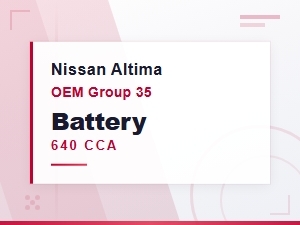 Nissan Altima Oem Battery Group Size and Cca Rating Guide
 Compatible Battery Group Size for 2005 Nissan Altima – Find the Right Fit
 Nissan Altima Battery Group Size Specifications by Year
 Best Battery Options for Your Nissan Altima
 Nissan Altima Battery Replacement Cost Estimate and Recommendations