If you own a Nissan Altima and your car won't start on a cold morning, there's a good chance the battery is the problem. But before you rush to buy a replacement, you need to know one thing: the correct battery group size for your specific Altima model. Getting this wrong means the battery won't fit properly, won't connect right, and could damage your electrical system. Knowing the right Nissan Altima battery group size specifications saves you time, money, and a call to the tow truck.
What battery group size does the Nissan Altima take?
Most Nissan Altima models use a Group 35 battery. This is the standard size for the majority of Altima production years, from the mid-2000s through recent model years. The Group 35 designation refers to a specific set of physical dimensions (roughly 9.06 x 6.88 x 8.75 inches) set by the Battery Council International (BCI).
The group size tells you three things: the battery's length, width, and height, plus the terminal placement. If any of these are off, the battery tray won't hold it securely and the cables may not reach the terminals.
For a full breakdown of dimensions and specs, you can review this detailed battery group size specification guide that covers every measurement you need to know.
Does the battery group size change depending on the model year?
Yes, it can. While Group 35 is the most common, not every Altima year uses the same size.
- 2002–2006 Altima (3.5L V6 and 2.5L I4): Group 35 is standard, though some 2005 models may differ slightly depending on trim and engine. If you drive a 2005 Altima, check this year-specific battery compatibility guide before purchasing.
- 2007–2012 Altima: Group 35 remains the standard across both the 2.5L and 3.5L engines.
- 2013–2018 Altima: Group 35 for most trims. The 2.5L and 3.5L engines still share the same battery group size.
- 2019–2024 Altima: Group 35 continues, though some newer trims with start-stop technology may call for an AGM (Absorbent Glass Mat) battery of the same group size rather than a standard flooded lead-acid type.
How do I check which battery group size my Altima actually needs?
There are three reliable ways to confirm the right size:
- Check your owner's manual. The battery specifications section lists the BCI group number, CCA rating, and reserve capacity. This is the most trustworthy source.
- Look at the existing battery. The group number is printed on the label. If the battery in your car right now is the original OEM unit, the label should read Group 35.
- Use an online fitment tool. Auto parts store websites let you enter your year, make, model, and engine size to pull up the correct battery. These tools pull from manufacturer databases and are usually accurate.
What does CCA rating mean and why does it matter for the Altima?
CCA stands for Cold Cranking Amps. It measures how much current a battery can deliver at 0°F for 30 seconds while maintaining at least 7.2 volts. In plain terms, it tells you how well the battery starts your engine in cold weather.
The Nissan Altima typically requires a battery with a CCA rating between 550 and 640 amps, depending on the engine. The 2.5L four-cylinder engine needs fewer cranking amps than the 3.5L V6, which has higher compression and needs more power to turn over.
Buying a battery with too low a CCA rating means hard starts in winter. Going much higher than needed won't hurt your car, but you'll pay more for capacity you don't use. For the OEM-recommended CCA specs, see this OEM battery group size and CCA rating reference.
What are the most common mistakes when buying a replacement battery?
Here are the errors we see most often:
- Assuming all Altimas use the same battery. The group size is usually consistent, but the battery type (flooded vs. AGM) and CCA requirements can differ by year and trim. Always verify.
- Ignoring terminal orientation. Group 35 batteries have the positive terminal on the left side. If you accidentally grab a Group 24F (same width, different terminal position), the cables won't reach and you risk a reverse-polarity connection. That can fry electronics.
- Choosing based only on price. A cheap battery with low CCA and a short warranty might save you $30 today but leave you stranded in six months. Look at warranty length and CCA as your main comparison points.
- Forgetting to check the battery tray and hold-down. A Group 35 battery that's slightly taller (some brands vary by fractions of an inch) might not sit flush. Test-fit before you tighten everything down.
- Not registering the new battery. Some newer Altimas with intelligent charging systems benefit from a battery registration scan using an OBD-II tool. This tells the car's computer that a fresh battery is installed so it adjusts charging rates properly.
Can I use a different group size if Group 35 isn't available?
It's not recommended, but in a pinch, a Group 24F is physically close in size to a Group 35. However, the terminal positions are reversed (positive on the right instead of the left), and the height may differ. This means the hold-down bracket might not clamp correctly, and you'd need to reroute cables.
If your local store is out of Group 35 batteries, it's better to wait or try another store than to force-fit a different group size. A poorly fitting battery vibrates, wears out faster, and can crack from stress on the case.
How long does a Nissan Altima battery usually last?
A typical Altima battery lasts 3 to 5 years. Climate plays a big role. In hot southern states, heat accelerates chemical degradation inside the battery, often shortening life to 2–3 years. In cooler northern climates, batteries tend to last closer to 4–5 years.
Signs your battery is failing:
- Slow engine crank when starting
- Dashboard battery warning light staying on
- Headlights dimming at idle
- Electrical accessories acting erratically
- Swollen or leaking battery case
What's the best way to extend battery life in my Altima?
A few habits make a real difference:
- Drive regularly. Short trips don't give the alternator enough time to fully recharge the battery. If you mostly drive short distances, consider a trickle charger for the weekends.
- Keep terminals clean. Corrosion builds up on battery terminals and creates resistance. Clean them with a wire brush and a baking soda-water mix every 6–12 months.
- Secure the hold-down clamp. A loose battery vibrates during driving, which damages internal plates over time.
- Turn off accessories before shutting off the engine. Leaving headlights, the radio, or phone chargers running when the engine is off drains the battery.
- Get the charging system tested annually. A weak alternator can undercharge the battery without obvious symptoms until it's too late.
Practical checklist before you buy
- Confirm your exact model year, engine size (2.5L or 3.5L), and trim level.
- Look up the BCI group number in your owner's manual or on the current battery label.
- Check the required CCA rating (550–640A for most Altima models).
- Decide between standard flooded and AGM AGM lasts longer and handles deep cycling better, especially if you have start-stop technology.
- Compare warranties aim for at least a 3-year free replacement period.
- Test-fit the battery in the tray before tightening the hold-down.
- Use an OBD-II scanner to register the new battery if your year/model supports it.
If you want a clean visual reference for typographic projects while you work on car documentation, check out Montserrat it pairs well with technical manuals and spec sheets.
Next step: Grab your owner's manual right now, flip to the battery section, and write down your group size and CCA rating. Tape it inside your glove box so you're never guessing when the time comes to replace it.
 Nissan Altima Battery Size and Replacement Instructions Guide
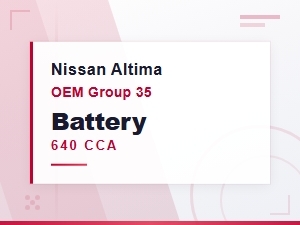 Nissan Altima Oem Battery Group Size and Cca Rating Guide
 Compatible Battery Group Size for 2005 Nissan Altima – Find the Right Fit
 Nissan Altima Battery Group Size Guide by Year
 Best Battery Options for Your Nissan Altima
 Nissan Altima Battery Replacement Cost Estimate and Recommendations