If you've ever stood in an auto parts store staring at a wall of car batteries, you know how confusing it gets. Knowing your Nissan Altima battery group size specifications before you shop saves you time, money, and the headache of buying the wrong battery. The group size tells you the exact physical dimensions, terminal placement, and power rating that fit your specific Altima model year. Get it wrong, and the battery won't sit right in the tray, the cables might not reach, or worse you could damage your car's electrical system.
What does battery group size actually mean?
Battery group size is a standardized classification created by the Battery Council International (BCI). It defines the length, width, height, and terminal configuration of a battery. For example, Group 51R and Group 35 are two common sizes used across different Nissan Altima model years. The number isn't about how much power the battery stores it's about whether the battery physically fits your car's battery tray and whether the positive and negative terminals line up with your cables.
This matters because even a battery with the right voltage can cause problems if the terminals are on the wrong side. Your positive cable might stretch across the engine bay awkwardly, creating a short-circuit risk. Group size prevents that mismatch.
What battery group size does my Nissan Altima need?
The group size depends on your Altima's model year and engine. Here's what the most common Altima generations require:
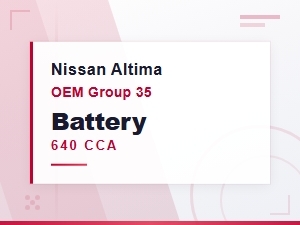
- 2013–2018 Nissan Altima (2.5L and 3.5L): BCI Group 35
- 2007–2012 Nissan Altima (2.5L and 3.5L): BCI Group 35
- 2002–2006 Nissan Altima (2.5L): BCI Group 35
- 1998–2001 Nissan Altima: BCI Group 35 or Group 51R (check your specific trim)
- 2019–2024 Nissan Altima: BCI Group 35 or Group 48 (H6), depending on trim and whether it has Auto Stop/Start
If you own a 2005 model specifically, you can find more targeted recommendations in this guide on the best battery options for a 2005 Altima.
How do I check my Altima's battery group size myself?
You have a few reliable ways to confirm the right group size:
- Check your owner's manual. The battery specifications section lists the BCI group size directly.
- Look at your current battery. Most batteries have the group size printed on the top or side label in large text (e.g., "35" or "51R").
- Use an online lookup tool. Sites like Interstate Batteries let you enter your year, make, and model to find the exact group size.
- Ask at the parts counter. AutoZone, O'Reilly, and Advance Auto Parts all have database lookups by VIN or vehicle info.
If your current battery label is faded or hard to read, you can also measure it yourself. A Group 35 battery measures roughly 9.1 x 6.9 x 8.9 inches (L x W x H). If your battery tray matches those dimensions and the terminals are on the correct sides, you've confirmed the group size.
Can I use a different group size than what Nissan recommends?
Technically, some group sizes are close enough in dimension that they might fit the tray. But it's not a good idea unless you've verified a few things:
- Terminal polarity and position. If the positive terminal is on the opposite side from your cable, forcing a fit creates safety risks.
- Cold Cranking Amps (CCA). A different group size might have lower CCA than your Altima needs, especially in cold climates.
- Warranty implications. Using an incorrect battery group size could void coverage on your vehicle's electrical components if something goes wrong.
Sticking with the manufacturer-specified group size is the safest bet. You can compare specifications across model years using our detailed Altima battery specs page.
What cold cranking amps does the Nissan Altima require?
CCA measures how well a battery starts your engine in cold weather. For most Nissan Altima models, you'll want at least:
- 2.5L engine: Minimum 550 CCA (most Group 35 batteries deliver 600–700 CCA)
- 3.5L V6 engine: Minimum 640 CCA
- 2019+ models with Auto Stop/Start: AGM batteries with 700+ CCA are typically required
Always match or exceed the CCA rating from your owner's manual. Going below that number means your Altima may struggle to start in winter mornings.
What common mistakes do people make when buying a replacement battery?
Here are the errors I see most often:
- Ignoring the "R" designation. A Group 51 and Group 51R have the same dimensions, but the terminals are reversed. Mixing them up means the cables won't reach properly.
- Buying based on price alone. The cheapest battery might have lower CCA, shorter reserve capacity, and a one-year warranty instead of three.
- Forgetting about AGM vs. flooded. Newer Altimas with Auto Stop/Start systems need AGM (Absorbent Glass Mat) batteries. A standard flooded battery will work short-term but degrade faster under the demands of that system.
- Not checking the manufacture date. A battery sitting on a shelf for 18 months has already lost some of its usable life. Look for a date code sticker on the case.
How much should a replacement battery cost for a Nissan Altima?
Prices vary by brand and battery type:
- Standard flooded Group 35: $120–$170
- AGM Group 35: $180–$250
- Premium options (Optima, Odyssey): $220–$300+
Installation is usually free at auto parts stores. If you want a full breakdown of costs and brand comparisons, check out our battery replacement cost estimate.
How long does a Nissan Altima battery typically last?
Most Altima batteries last 3 to 5 years, depending on climate and driving habits. Extreme heat shortens battery life more than cold does batteries in Arizona or Texas often fail sooner than those in moderate climates. Short trips (under 15 minutes) also reduce lifespan because the alternator doesn't have enough time to fully recharge the battery after each start.
If your Altima is approaching the four-year mark, it's worth getting the battery tested. Most auto parts stores will test it for free in under two minutes.
Do newer Altimas use a different battery type than older ones?
Yes. Starting around 2019, many Altima trims came equipped with AGM batteries from the factory because of the Auto Stop/Start system. AGM batteries handle repeated deep cycling better than traditional flooded batteries. If your Altima has this feature, replacing the battery with another AGM not a flooded type keeps the system working correctly.
Using a flooded battery in an Auto Stop/Start vehicle won't cause immediate damage, but you'll notice the system disabling itself more often, and the battery will wear out faster than expected.
Quick checklist before buying your next Altima battery
- ✅ Confirm your Altima's model year and engine size
- ✅ Verify the BCI group size (usually Group 35 for most model years)
- ✅ Check if your car needs an AGM or flooded battery
- ✅ Match or exceed the minimum CCA rating
- ✅ Read the manufacture date on the battery label avoid anything older than 6 months
- ✅ Confirm terminal position matches your cable layout
- ✅ Compare warranty length (3-year free replacement is standard for quality batteries)
Getting the right group size is the foundation of a good battery replacement. Start there, match the specs to your driving conditions, and you'll avoid the most expensive mistakes. If your Altima is still on its original battery and it's been more than four years, schedule a battery test soon before you end up stranded in a parking lot.
 Best Battery Options for Your Nissan Altima
 Nissan Altima Battery Replacement Cost Estimate and Recommendations
 Best Battery for 2005 Nissan Altima and Step-by-Step Replacement Guide
 Nissan Altima 3.5 V6 Battery Cold Cranking Amps Guide and Recommendations
 Nissan Altima Battery Size and Replacement Instructions Guide
 Nissan Altima Oem Battery Group Size and Cca Rating Guide