If you drive a Nissan Altima with the 3.5 V6 engine and live anywhere temperatures drop below freezing, knowing the right cold cranking amps (CCA) for your battery isn't just a detail it's what stands between you and a car that won't start on a January morning. The 3.5-liter V6 is a bigger engine than the standard 2.5, which means it demands more power from the battery to turn over, especially when the cold thickens your oil and slows chemical reactions inside the battery. Getting the CCA number wrong can lead to sluggish starts, premature battery failure, or being stranded in a parking lot with a dead engine.
What are cold cranking amps, and why does the 3.5 V6 need more of them?
Cold cranking amps measure how many amps a battery can deliver at 0°F (−18°C) for 30 seconds while maintaining at least 7.2 volts. It's basically a snapshot of your battery's ability to start your engine in cold weather. The higher the CCA rating, the more starting power the battery provides when temperatures drop.
The 3.5 V6 Altima has a larger displacement engine with more cylinders to fire. It needs a stronger initial burst of energy to crank over compared to the 2.5-liter four-cylinder version. In warmer climates, you might get away with a lower CCA, but in northern states or anywhere winter hits hard, cutting corners on CCA is asking for trouble.
How many CCA does a Nissan Altima 3.5 V6 actually need?
Nissan generally specifies a minimum of 650 CCA for the 3.5 V6 Altima, though most mechanics and battery manufacturers recommend shooting for 700 to 800 CCA for reliable performance. Here's a rough breakdown:
- Mild climate (rarely below 32°F): 650 CCA is the minimum. You'll get by, but there's little margin for error as the battery ages.
- Moderate cold (lows around 0°F to 20°F): 700–750 CCA gives you a comfortable buffer.
- Severe cold (regularly below 0°F): 800+ CCA is your safest bet. Batteries lose roughly 35% of their cranking power at 0°F and up to 60% at −20°F.
Going above the minimum never hurts a battery with more CCA than you "need" simply won't work as hard to start your engine, which can extend its lifespan. If you're unsure about the right group size along with CCA, check our breakdown of Nissan Altima battery group size specifications to make sure you're matching the correct physical fit as well.
What battery group size pairs with the right CCA for this engine?
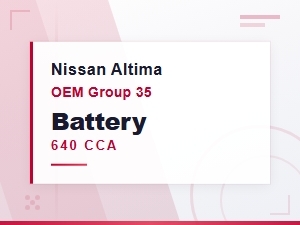
The 3.5 V6 Altima typically uses a Group 35 battery. This is important because CCA ratings are tied to the battery's physical size and plate design. You can't just pick any battery with the right CCA it also has to fit the tray, align with the terminal positions, and match the hold-down configuration.
Group 35 batteries are widely available from brands like Interstate, Optima, DieHard, ACDelco, and Duralast. Most quality Group 35 batteries in the 700–800 CCA range run between $130 and $220, depending on the brand and warranty. For an idea of what a full replacement might cost including labor, see our Nissan Altima battery replacement cost estimate.
Does a higher CCA always mean a better battery?
Not necessarily. CCA is one piece of the puzzle, but it's not the only thing that matters. Here's what else to consider:
- Reserve capacity (RC): This tells you how long the battery can run essential electronics if the alternator fails. A battery with 120+ minutes of RC is a solid choice.
- Warranty length: A battery with 800 CCA but a 1-year warranty isn't as good a deal as one with 750 CCA and a 3-year free replacement warranty.
- Battery type: Standard flooded lead-acid batteries work fine for most Altima owners. AGM (Absorbent Glass Mat) batteries handle vibration better, charge faster, and maintain voltage more consistently but they cost more.
- Age of the battery on the shelf: A battery with a manufacture date more than 6 months old may already have lost some capacity before you even install it.
What are common mistakes people make with CCA and battery selection?
- Buying the cheapest battery that meets the minimum CCA: You save $30 upfront but might replace it a year sooner. Over the life of the car, the more expensive battery with better specs usually costs less.
- Ignoring climate: If you bought your Altima in Florida and moved to Minnesota, your battery needs changed. Reassess your CCA needs based on where the car lives now, not where it was purchased.
- Assuming all Group 35 batteries have the same CCA: They don't. Group 35 batteries range from roughly 640 CCA to 850 CCA depending on the manufacturer and product line.
- Forgetting about parasitic drain: If your Altima sits for days without being driven, a battery on the lower end of the CCA range will struggle more. Modern Altimas have electronics that draw small amounts of power even when the car is off.
- Not checking terminal orientation: The 3.5 V6 Altima needs positive on the right side. Installing a battery with reversed terminals can damage electrical components.
How long should a battery with the right CCA rating last?
A quality Group 35 battery with adequate CCA typically lasts 3 to 5 years in a Nissan Altima. In extreme heat climates (Arizona, Texas summers), expect the shorter end of that range because heat accelerates internal corrosion. In moderate climates with the right CCA buffer, you might push past 5 years.
A few signs your battery is losing its cranking power even if it hasn't hit the typical lifespan:
- The engine turns over slower than usual, especially on cold mornings
- Dashboard lights dim when you turn the key
- You hear a rapid clicking sound when trying to start
- The battery voltage reads below 12.4 volts when the engine is off (measured with a multimeter)
Should you choose an AGM or standard flooded battery for the 3.5 V6?
For most 3.5 V6 Altima owners, a standard flooded lead-acid battery with 700+ CCA does the job well. But an AGM battery makes sense if you:
- Live in an area with severe winters and need maximum cold-weather reliability
- Have added aftermarket electronics (amplifiers, dash cams, GPS trackers)
- Drive short trips frequently, which means the alternator doesn't fully recharge the battery each time
- Want a battery that handles engine vibration better and has a longer cycle life
AGM batteries for Group 35 typically start around $180 and can go up to $280. The extra cost usually pays off in longevity and more consistent starting power. When storing battery receipts and records, some owners find it helpful to use organized documents fonts like Lato are clean and easy to read on printed maintenance logs.
What's the best way to test if your current battery still has enough CCA?
A battery can show 12.6 volts and still fail under load because voltage alone doesn't tell you about cranking capacity. Here's how to check:
- Free testing at auto parts stores: AutoZone, O'Reilly, and Advance Auto Parts will test your battery's CCA for free using a conductance tester. This gives you a read on whether your battery is still delivering close to its rated CCA.
- Load testing: A mechanic applies a controlled load to the battery and measures voltage drop. This is the most accurate real-world simulation of what happens during a cold start.
- Using a multimeter at home: Measure voltage with the engine off. Below 12.4V means the battery is partially discharged. Below 12.0V means it's essentially dead. But remember this tests state of charge, not CCA capacity.
Quick checklist before buying your next battery
Run through this list before you head to the store or order online:
- Confirm Group 35 is the correct size for your model year (2002–2018 3.5 V6 Altimas generally use this)
- Target 700–800 CCA minimum, higher if you live in a cold climate
- Check the manufacture date on the battery avoid anything older than 6 months
- Compare warranty terms, not just price a 3-year free replacement warranty is the sweet spot
- Verify terminal orientation positive terminal should be on the right side
- Consider AGM if you face extreme weather, heavy electrical loads, or lots of short trips
- Get a free battery test on your current battery before replacing it you might just need a recharge
 Best Battery Options for Your Nissan Altima
 Nissan Altima Battery Replacement Cost Estimate and Recommendations
 Nissan Altima Battery Group Size Specifications and Recommendations
 Best Battery for 2005 Nissan Altima and Step-by-Step Replacement Guide
 Nissan Altima Battery Size and Replacement Instructions Guide
 Nissan Altima Oem Battery Group Size and Cca Rating Guide