Getting the right battery group size for your 2005 Nissan Altima isn't just a small detail it's the difference between a car that starts reliably every morning and one that leaves you stranded in a parking lot. The wrong size can lead to poor electrical performance, terminal corrosion, or even damage to your car's electrical system. If you're dealing with a dead battery or planning a replacement, knowing the exact group size your Altima needs saves you time, money, and frustration.
What battery group size does a 2005 Nissan Altima actually need?
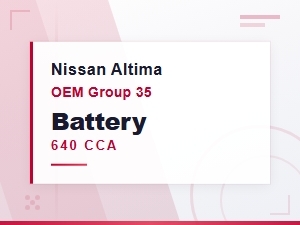
The 2005 Nissan Altima uses two different battery group sizes depending on the engine under the hood. If your Altima has the 2.5-liter four-cylinder engine, it takes a Group 35 battery. If it has the 3.5-liter V6 engine, it uses a Group 24F battery. These numbers refer to the Battery Council International (BCI) standard sizing system, which defines the physical dimensions, terminal placement, and power specs of each battery type.
The group number tells you more than just how big the battery is. It also determines where the positive and negative terminals sit, how the battery fits in the tray, and whether the hold-down clamp aligns properly. Using the wrong group size means the battery may not physically fit, or the cables might not reach the terminals without stretching or bending both of which cause real problems.
Why does the engine type change the battery group size?
The 2.5L and 3.5L engines have different electrical demands. The V6 engine in the 3.5L model requires more cold cranking amps (CCA) to start, and Nissan sized the battery tray and cable routing to fit a larger Group 24F unit. The four-cylinder model has a smaller tray and shorter cable runs designed around the Group 35 battery.
Here's a quick breakdown of the key specs:
- Group 35 (2.5L four-cylinder): Approximately 9.1" L × 6.9" W × 8.9" H. Typical CCA rating ranges from 640 to 750 amps. Right-side positive terminal.
- Group 24F (3.5L V6): Approximately 10.3" L × 6.8" W × 8.9" H. Typical CCA rating ranges from 700 to 850 amps. Right-side positive terminal.
Both group sizes share the same terminal orientation, but the Group 24F is noticeably longer. That extra length gives it more reserve capacity, which the V6 engine needs during cold starts and when running the air conditioning, audio system, and other electronics simultaneously.
How do I check which engine my 2005 Altima has?
If you're not sure which engine is in your Altima, you can check a few easy places:
- Look at the vehicle identification number (VIN) on your registration or dashboard. The eighth character of the VIN indicates the engine type.
- Open the hood and look for the engine cover. The 2.5L is usually stamped or labeled "2.5" and the 3.5L says "3.5" or "VQ35DE."
- Check your owner's manual or the under-hood emission sticker.
If you want a hands-on walkthrough, this guide on finding the correct battery group size covers identification steps in detail.
What happens if I install the wrong battery group size?
Putting a Group 24F battery in a car designed for Group 35 (or the other way around) creates several problems:
- Fitment issues: A Group 24F battery is over an inch longer than a Group 35. In a tray built for Group 35, it simply won't sit right. The hold-down bracket won't clamp it, and the battery can shift or vibrate during driving.
- Cable strain: If the terminals don't line up, the battery cables stretch or twist. Over time, this damages the cable insulation and can cause voltage drops or shorts.
- Electrical problems: A battery with insufficient CCA for your engine leads to slow cranking, dim headlights, and premature battery failure especially in cold weather.
- Warranty concerns: Many battery manufacturers void the warranty if the battery was installed in a vehicle it wasn't rated for.
The cost difference between the correct group size and the wrong one is usually small. The cost of fixing damage from a bad installation is not.
Can I upgrade to a higher CCA battery within the correct group size?
Yes, and this is a smart move for many owners. Within the same BCI group number, different manufacturers offer varying CCA ratings. For a 2005 Altima with the 2.5L engine, you can find Group 35 batteries rated anywhere from 640 to 750 CCA. Going with a higher-rated battery within Group 35 gives you better starting power without any fitment issues.
The same applies to Group 24F for the V6 model. A higher CCA rating within the correct group size is a straightforward upgrade that improves reliability, especially if you live in a region with harsh winters or frequently use accessories while the engine is off.
Where can I buy the right battery for my 2005 Altima?
Auto parts stores like AutoZone, O'Reilly, and Advance Auto Parts use vehicle lookup tools that match your year, make, model, and engine to the correct group size. You can also find the right fit online. If you've already confirmed you need a Group 24F, this resource on purchasing the Group 24F battery walks you through what to look for.
When comparing batteries, pay attention to these specs:
- Cold Cranking Amps (CCA): Higher is better for cold climates.
- Reserve Capacity (RC): How long the battery can run essential electronics if the alternator fails.
- Warranty: Look for at least a 2–3 year free replacement warranty.
- Terminal type: Make sure the post style (top-post vs. side-post) matches your cables.
What are common mistakes people make during battery replacement?
Replacing a car battery seems simple, but small errors cause big headaches:
- Not verifying the engine type first: Buying a battery based only on "2005 Nissan Altima" without checking whether it's the 2.5L or 3.5L leads to buying the wrong group size.
- Ignoring terminal orientation: Even within the correct group size, some aftermarket batteries reverse the terminal positions. Always compare the old and new battery side by side before installing.
- Skipping the hold-down clamp: A loose battery moves around under the hood, which cracks the case or damages internal plates over time.
- Forgetting to clean terminals: Corrosion on the cable connectors reduces conductivity. Clean them with a wire brush and apply anti-corrosion grease before connecting the new battery.
- Not resetting electronics: Some 2005 Altima models lose radio presets and may need the idle relearn procedure after a battery swap. Keep your radio code handy if applicable.
How can I troubleshoot battery issues before replacing it?
Before you spend money on a new battery, make sure the battery is actually the problem. A weak alternator, corroded cables, or a parasitic drain can mimic a dead battery. Use a multimeter to check voltage a healthy battery reads around 12.6 volts with the engine off. Below 12.2 volts suggests it needs charging or replacement.
For a step-by-step troubleshooting process, this DIY battery check guide covers testing methods that don't require special tools beyond a basic multimeter.
Some brands known for producing reliable typefaces, like Roboto, are often used in automotive manuals and dashboard displays which is why so many repair instructions look the way they do. Understanding how your car's systems are documented can help you follow service procedures more accurately.
How long should a battery last in a 2005 Nissan Altima?
Most car batteries last between 3 to 5 years. In hot climates, batteries tend to fail sooner because heat accelerates internal chemical breakdown. In cold climates, batteries that are already weakened by age tend to die suddenly during the first deep freeze.
If your current battery is over three years old and you've noticed slow engine cranking, flickering interior lights, or the battery warning light appearing intermittently, it's time to test it or replace it proactively. Waiting until it dies completely often means it happens at the worst possible time.
Quick checklist for your 2005 Nissan Altima battery replacement
- Confirm your engine size 2.5L needs Group 35, 3.5L needs Group 24F.
- Compare terminal positions on your old battery and the new one before purchasing.
- Choose a CCA rating at or above the original spec for your engine.
- Clean battery terminals and cable connectors with a wire brush.
- Secure the hold-down clamp don't skip this step.
- Test voltage after installation to confirm proper charging (13.5–14.5V with engine running).
- Reset your clock, radio presets, and perform the idle relearn if needed.
- Keep your receipt and note the installation date for warranty tracking.
Tip: Write the installation date on the battery with a permanent marker. When the battery reaches the three-year mark, start testing it regularly so you're never caught off guard by a dead battery on a cold morning.
 Nissan Altima Battery Group Size Check Diy Troubleshooting Guide
 How to Find Battery Group Size for 2005 Nissan Altima Troubleshooting
 Common Battery Group Size Problems in 2005 Nissan Altima
 Nissan Altima Battery Size and Replacement Instructions Guide
 Nissan Altima Oem Battery Group Size and Cca Rating Guide
 Compatible Battery Group Size for 2005 Nissan Altima – Find the Right Fit